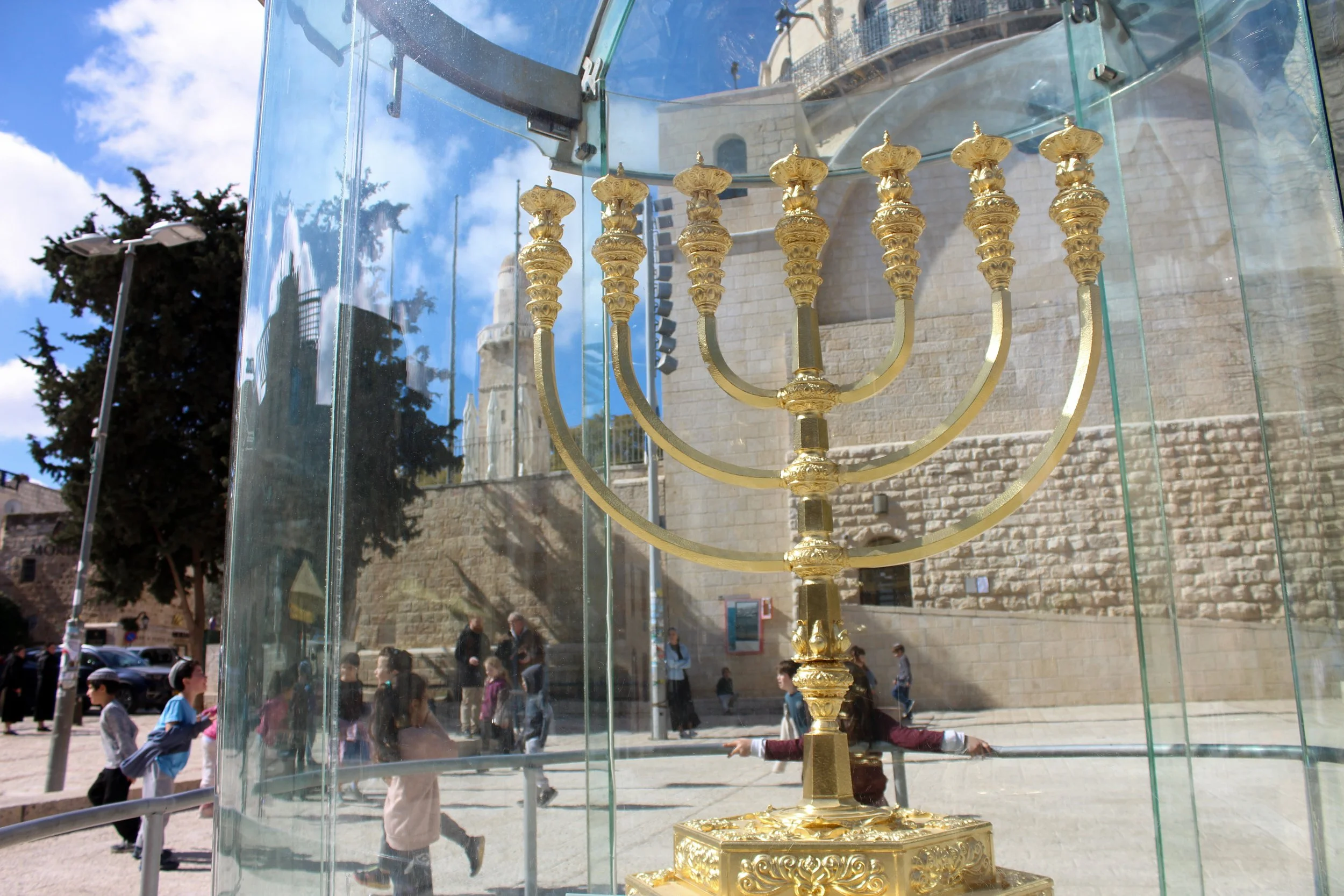
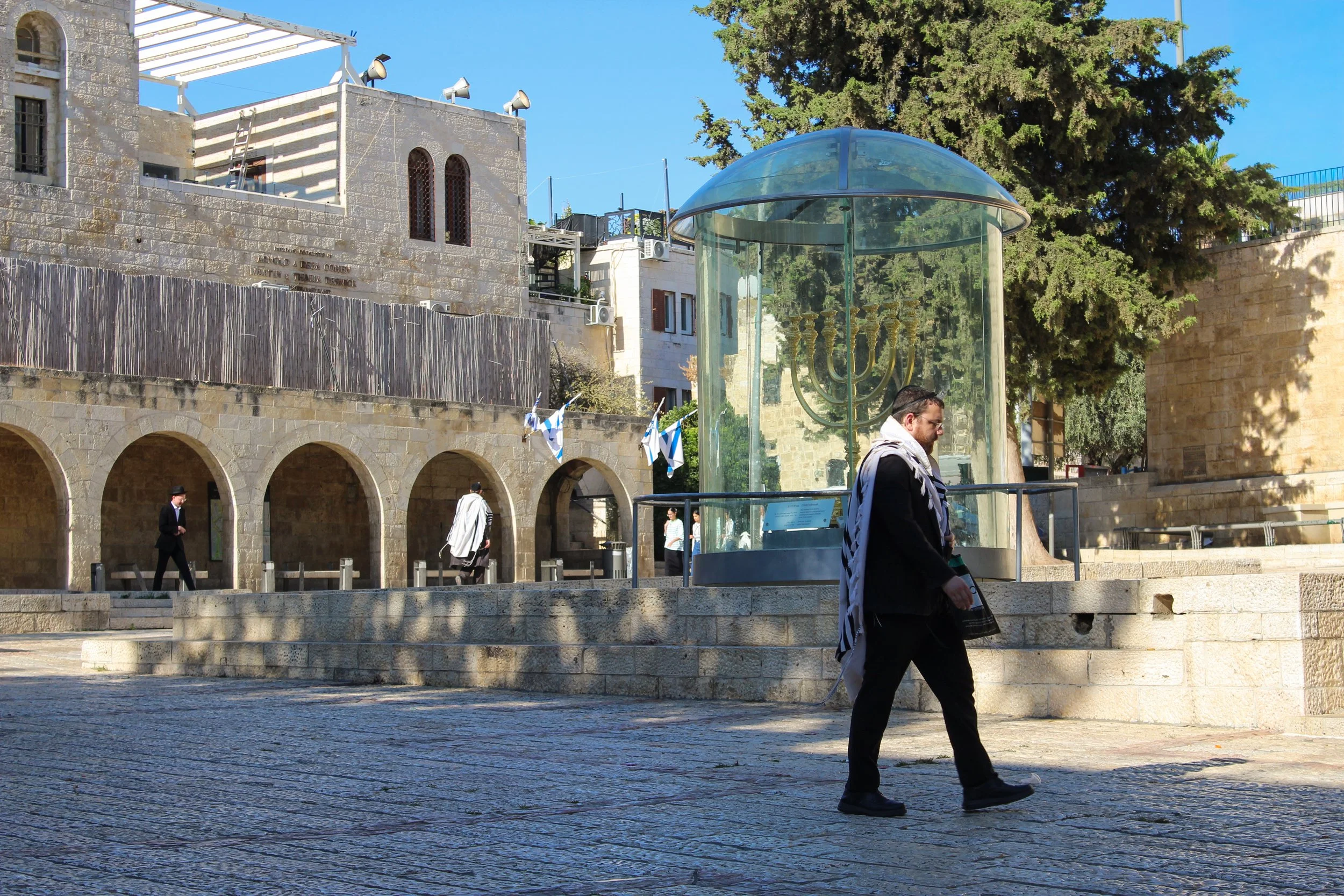
At the heart of the Old City’s Jewish Quarter lies Hurva Square, one of Jerusalem’s most beloved gathering places. Just a short walk from the Western Wall, this open plaza is surrounded by shops, cafes and the golden-domed Hurva Synagogue, drawing residents and visitors alike into its ancient rhythm of daily life. It’s here, just off the square, that Moshe Kempinski’s shop Shorashim (“Roots”) has stood since 1986, known as a gathering place for Bible study and interfaith dialogue in the Jewish Quarter.
The Hurva Synagogue itself carries a story of ruin and restoration that mirrors the Jewish Quarter’s own history. A synagogue was first raised on this site in the early 1700s by Ashkenazi followers of Rabbi Judah HeHasid, atop the remains of a synagogue that had stood there since the 15th century. Crushing debt led local creditors to burn it down in 1721, leaving it a ruin for well over a century, hence its name: Hurva, “the ruin.” Rebuilt in 1864, it became the grandest and most prominent synagogue in the Old City, only to be destroyed a second time in 1948, when Jordan’s Arab Legion demolished it during the fighting that drove Jews from the Jewish Quarter. For 19 years, no Jewish community remained there at all.
That changed in June 1967. When Israeli paratroopers broke through the Lion’s Gate and reclaimed the Old City during the Six Day War, Jews returned to the Quarter for the first time in nearly two decades. The plaza beside the synagogue’s ruins, by then a parking lot, was later redeveloped into today’s Hurva Square, and in 2010, the synagogue itself was fully rebuilt and rededicated, once again anchoring Jewish life and worship in the heart of the Old City.
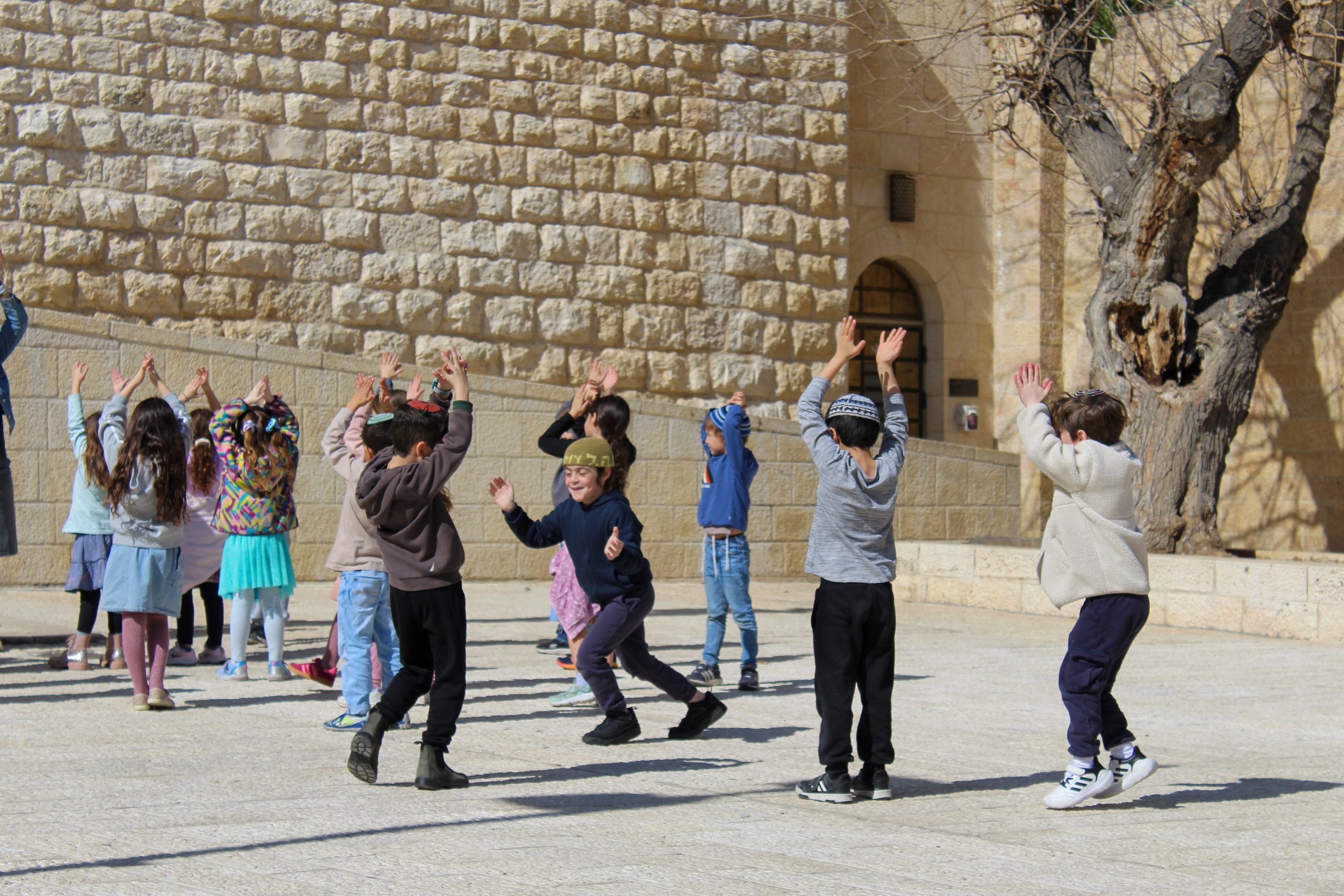
Scripture speaks of exactly this kind of return. The prophet Zechariah promised that Jerusalem’s streets will once again be filled with “boys and girls playing in its streets,” and “old men and old women shall again sit in the streets of Jerusalem” (Zech. 8:4–5). Isaiah also foretold that God’s people would “rebuild the old ruins” and “raise up the former desolations, and they shall repair the ruined cities” (Isa. 61:4). Few places in Jerusalem embody that promise as vividly as Hurva Square, a plaza rebuilt from rubble, filled today with children playing, shoppers browsing and neighbors gathering exactly where past generations once wept over its destruction.
To stand in Hurva Square is to stand inside a fulfilled prophecy, proof, as Moshe Kempinski says, that in this land, Scripture isn’t only something you read. It’s something you can watch come true before your eyes.
Capernaum